
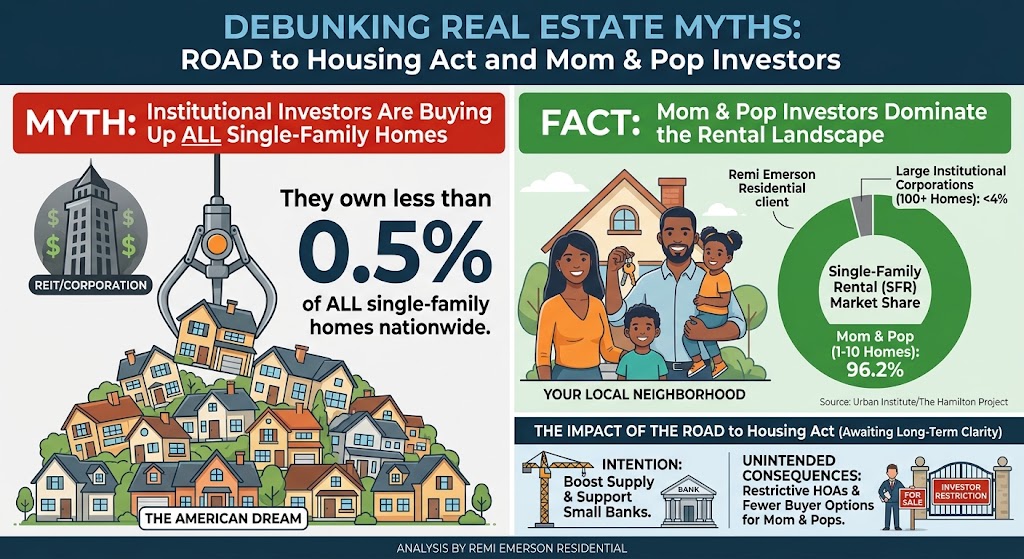
This ROAD to Housing Act is intended to boost the housing supply, deal with some outdated HUD programs, and offer more support to small banks. But, as real estate investors, we are most concerned with the part that restricts institutional investors from buying up all of the single-family homes.
This brings up so many questions. Such as, “Were institutional investors actually buying up all of the single-family homes?” Or we can even ask, “what is an ‘institutional’ investor?”
“What will this mean for mom and pop investors?”
At Remi Emerson Residential our clients are the classic American “mom and pop” investors. The majority of our clients own between one and three properties. Our large clients own eight to twelve. Trust me when I tell you that I’m not here to be an apologist for the big hedge funds or REITs out there competing with our clients and myself for properties and tenants. But I must admit that the answer to our first question is, “no, they were not buying up ALL of the single-family homes.” There is a section in the bill titled “Homes are for People, Not Corporations.” However, the evil corporations (assuming a corporation becomes evil when it owns 350 or more properties) actually own less than ½ of a percent of single-family homes nationwide. That ½ of one percent is divided up amongst at least six of these evil corporations.
Corporate Market Share vs. Mom & Pop Ownership Data
When you take the rental sector by itself these large companies own less that 3% (The Hamilton Project study) or if you lower the barrier of entry to “evil corporation” down to 100 homes they own 3.8% of the single family rentals (Urban Institute study). This is still not a number that would ruffle any feathers in any other industry. In fact, nationwide, the single largest holder of SFR’s is Progress Residential with about 88,000 homes. That’s a bunch! However, that accounts for well below 1% of the SFR stock out there. Combine them with the second largest, Invitation Homes, and together they don’t even come close to 1% of the market share.
Just for fun, let’s compare that to some other industries. Google owns 91% of the Global Search Market. Microsoft owns 80% of the desktop operating systems market share. Amazon now controls over 40% of the US e-commerce market share.
Since we operate in Central Florida we may be more effected by these big players than other areas. Some estimates place the number of SFR’s owned by companies with more than 100 units in Central Florida at around 15% of the market share. But even in the Sun Belt cities where these companies own most of their properties the Mom and Pop investors still dominate the landscape.
It would seem that legislation aimed at cutting these giants off at the knees would be good for the mom and pops and it may turn out to be helpful at some point down the road, but right now this entire debate has done the industry more harm than good.
Currently, even though ROAD act is now law, there is no enforcement mechanism and it may be years before anyone understands just how this is going to be enforced or what the long-term effects will be. However, due to the publicity surrounding the idea that these huge companies are buying up all of the single-family homes-thereby squeezing new home owners out of the market, there has been some negative consequences to Mom and Pop investors.
The Myth of Wall Street Neighborhood Buyouts
The demonization of large real estate investors has been easy pickings for conspiracy crowd. Blaming the difficulty of obtaining the American dream of home ownership on rising interest rates, outrageous property taxes, insane HOA Fees (including one time “transfer fees” of thousands of dollars in some instances) and regulations that make starter homes completely unprofitable for builders to build isn’t nearly as fun and sexy as blaming the Evil Corporations. There were actually some YouTubers, who I won’t link to because they are lying fear mongers of the worst kind, who claimed that BlackRock was out there buying up entire neighborhoods and then using some sort of convoluted pump and dump scheme that raised the values over 20% in no time flat and netted the company billions and billions in profits. These profits came straight from the pockets of regular home-owners! These videos were often published with the subtitle “You’ll own nothing!” The problem is that BlackRock does not and never has owned a single-family home. That’s not what they do. Among other investments they do hold positions in mortgage backed securities, but that is a far cry from buying up single family homes by the entire neighborhood.
Unintended Consequences: How Local HOAs Are Hurting Small Investors in Central Florida
The result of this type of fear mongering has led to HOA boards, fearful that companies are going to come in and make their beautiful bedroom communities turn into a collection of poorly maintained dumps full of transients, to pass rules making it harder for sellers in their communities to sell to investors. There are two large subdivisions in eastern Orange County that prohibit home buyers from renting out properties until they have owned them for at least a year. This takes virtually every rent and hold investor off the table as a buyer in these communities. What do you think that does to home values in those communities?
It’s not just HOA boards. I have been told by agents on more than one occasion that their sellers will not sell to investors. These folks are well intentioned but are not helping anyone. They think they are protecting their soon to be former neighbors. But when a Remi Emerson client buys a house in a neighborhood that house gets inspected top to bottom and any needed repairs are done. That house subsequently gets inspected at least three times per year. Anyone who moves into that house goes through a thorough background check and signs a document stating that they agree to keep the house in proper condition and abide by all HOA rules. Additionally, anytime there are violations of the HOA rules it is corrected immediately. I’m pretty sure that’s not the case for the other homes on the street bought by non-investors.
Ultimately, the demonization of the investor class of home buyers leads to less opportunity for investors and drives up costs. This affects the cost of housing for everyone. Most investors out there are small investors working on a long-term wealth building plan. They aren’t billionaires and they certainly are not part of the problem.
So yea, it’s fun to see the big guys take it on the chin once in a while. I would love it if suddenly Invitation Homes had to sell the majority of their Central Florida portfolio. This would create a potential windfall opportunity for my investors and myself. But I have my doubts that is what’s going to happen as a result of this bill. Right now, it’s way too early to tell what the effects will be or even if there will be any noticeable effects at all. But the cost of the debate, which was never really grounded in any facts in the first place, is less opportunity for real estate investors as a whole and will result in more expensive housing for renters and less opportunities for the small investor.